Identifier
MGM

A runway diagram map print of Montgomery Regional (Dannelly Field) (MGM), made from the airport's own layout for the place it holds in your life. Choose your colorway and your format: a fine art giclée print on cotton paper, a framed fine art print, a glossy metal print or a digital download.
Your fine art print is made to order with pigment inks on heavyweight, 100% cotton Hot Press paper, a 330 gsm sheet with a high color gamut and deep black density. The acid-free, archival-grade paper has a smooth matte surface. Supplied unframed, ready for your own frame.
Choosing a gift? Read our gift guide for pilots.
Physical prints are made to order in 2 to 3 business days; shipping time is added on top and varies by your location and the method you choose. Standard shipping is free across the US. Orders containing only paper prints ship flat, though paper may retain a slight curl; orders with framed or metal pieces ship in separate boxes. Digital downloads are delivered by email, so there is nothing to ship.
The Digital Download is a JPEG at 300 dpi, sized for 24 by 30 inches. The digital add-on matches the selected physical print size at 300 dpi. Download links arrive by email and stay active for 30 days; save the file within that time and keep it for personal, non-commercial use. No physical item is shipped.
Physical products have a 30-day money-back guarantee. Contact us within 30 days of delivery to request a refund; we may require a return before issuing it.
Digital downloads are non-refundable once delivered, except where required by law or where AirportPrints determines that a delivery failure or technical issue was caused by AirportPrints.
Fine Art Print: pigment giclée printing on heavyweight 330 gsm (17 mil), 100% cotton Hot Press paper, on regularly calibrated giclée printers. The paper is acid-free and archival-grade, with a smooth matte surface and the high color gamut and black density that let a dark ground and fine linework keep their depth. Supplied unframed, with no added white margin, ready for your own frame.
Framed Fine Art Print: the same cotton fine art paper in a 1.25 inch solid wood frame. A white, acid-free, 4-ply mat with a 45-degree bevel and optical-grade, shatter-resistant clear acrylic (safer to ship than glass) are included. The print is mounted to foam core for a flat presentation, with a kraft paper dust cover and installed hanging wire on the back.
Glossy Metal Print: the image is transferred by dye sublimation into polymer-coated aluminum with a glossy white base. The 1.14 mm panel has a scratch- and water-resistant surface, with a hidden inset mount that positions it about 3/4 inch off the wall. Display indoors, away from direct sunlight.
Digital Download: a high-resolution JPEG for personal, non-commercial use. No physical paper, frame, or metal panel is included.
Fine Art Print: 8 x 10, 16 x 20, and 24 x 30 inches.
Framed Fine Art Print: 8 x 10, 16 x 20, and 24 x 30 inches, measured across the mat and acrylic area inside the frame. The mat sits within that area, so the visible image is about 6 x 8, 12 x 16, or 18 x 24 inches. The outside frame is larger than the listed size.
Glossy Metal Print: 8 x 10, 16 x 20, and 24 x 30 inches. During sublimation, 1/8 to 1/4 inch of the artwork may be cropped, so the printed edge can differ slightly from the preview.
Digital Download: a 7200 x 9000 pixel JPEG at 300 dpi for 24 x 30 inch printing. A digital add-on instead matches the selected physical size: 8 x 10, 16 x 20, or 24 x 30 inches at 300 dpi.
This is Montgomery's own layout, the way its runways run and the taxiways thread between them, composed into a print you will want to look at every day. Not a stock template with a new name on it.
Heavyweight 330 gsm, 100% cotton Hot Press paper, acid-free and archival-grade. Its high color gamut and black density give the runways real depth, and pigment inks keep the fine detail crisp on a smooth matte surface.
Frame it in 1.25 inch solid wood, black, white or natural oak, with the white beveled mat, optical-grade clear acrylic and hanging wire included. Or choose glossy metal: dye sublimation into aluminum, floated about 3/4 inch off the wall on a hidden mount.
Composed from published airport information and available field depictions as original wall art. Learn how AirportPrints maps take shape.
Montgomery Regional Airport, also known as Dannelly Field, works two asphalt runways set as a lopsided X. Runway 10/28 is 9,020 by 150 feet and runs east and west across the full width of the diagram, tipped very slightly down toward the 28 end. Runway 03/21 is 4,011 by 150 feet and cuts up from the lower left to the upper right, crossing the long runway well east of its midpoint, much closer to the 28 threshold than to the 10 threshold. Magnetic variation is 1W. That off centre crossing is what makes the composition: the long strip is divided into a wide left panel and a short right one, and the shorter runway hangs below the intersection with nothing on its southwest end but taxiway.
The airport sits seven miles southwest of downtown Montgomery, the capital of Alabama and, at the 2020 census, the state's fourth most populous city after Huntsville, Mobile and Birmingham. Commercial and military flying in the city have been tangled together from the start. The first air services used Maxwell Field west of town, and the municipal airport the city opened east of town in 1929 became Gunter Field. When the War Department took Gunter for pilot training in 1940, the city bought a tract southwest of downtown on US 80 to replace it, and the Army Air Forces adopted the same ground as Gunter's auxiliary field number six. It opened in 1943, named for Ensign Clarence Moore Dannelly Jr., a Navy pilot killed in a 1940 training accident and counted as the first World War II casualty from Montgomery. The city took title in 1946.
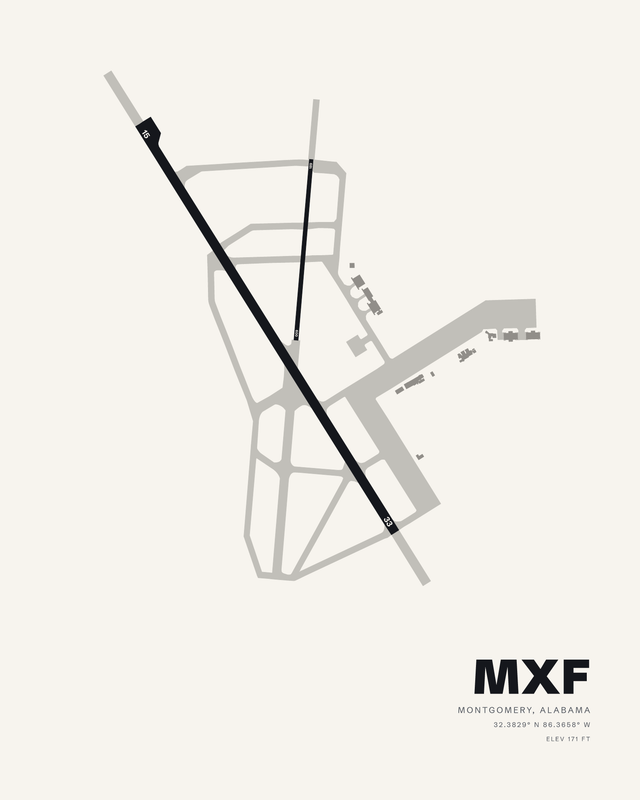
Some of the pavement on the print no longer serves a runway, which is part of why the grey geometry does not all line up with the two black strips. Dannelly opened with three runways. 15/33 was closed in 1981 and portions of it remain as taxiway and apron, while 9/27 was extended in 1955 and again in 1963 and was redesignated 10/28 in 1992. A long taxiway stem also runs well south of the field to a separate apron block, which gives the lower half of the sheet a quiet stretch of open ground.
As art, the field is left to speak plainly. Runway designators, lengths and widths follow the published figures, and taxiways, apron edges and building footprints are reduced to flat geometry over the ground tone you choose. The terminal and hangar blocks cluster along the north side of 10/28, so the top of the print carries the detail and the bottom carries the space. This is original wall art composed from published airport information and available field depictions rather than a navigation document, printed to order at a size that reads from across a room and still rewards standing close.
Two, both asphalt. Runway 10/28 is 9,020 by 150 feet and runway 03/21 is 4,011 by 150 feet. They cross east of the middle of the long runway, which is the shape the print is built around.
Runway 10/28 at 9,020 feet by 150 feet. It began life as runway 9/27, was extended in 1955 and again in 1963, and was redesignated 10/28 in 1992.
MGM is the IATA code for Montgomery Regional Airport, seven miles southwest of downtown Montgomery, the capital of Alabama. The field is named for Ensign Clarence Moore Dannelly Jr., a Navy pilot killed in a 1940 training accident who was counted as the first World War II casualty from Montgomery.
Dannelly opened with three runways, and 15/33 was closed in 1981 with portions kept as taxiway and apron. That leftover geometry, plus a long taxiway stem running south to a separate apron, is what gives the layout its odd angles.
The runway designators, lengths, widths and the crossing angle between the two strips come from published airport information for the field. It is original wall art, not a chart: fine details may be simplified or omitted, including minor taxiway markings, signage and small structures, and it is not for navigation.
Each print is made to order in several sizes and finishes, on a ground tone you pick at checkout. It reads well for anyone who has flown into Dannelly Field, worked on the ramp there, or grew up in the River Region.